%201.svg)


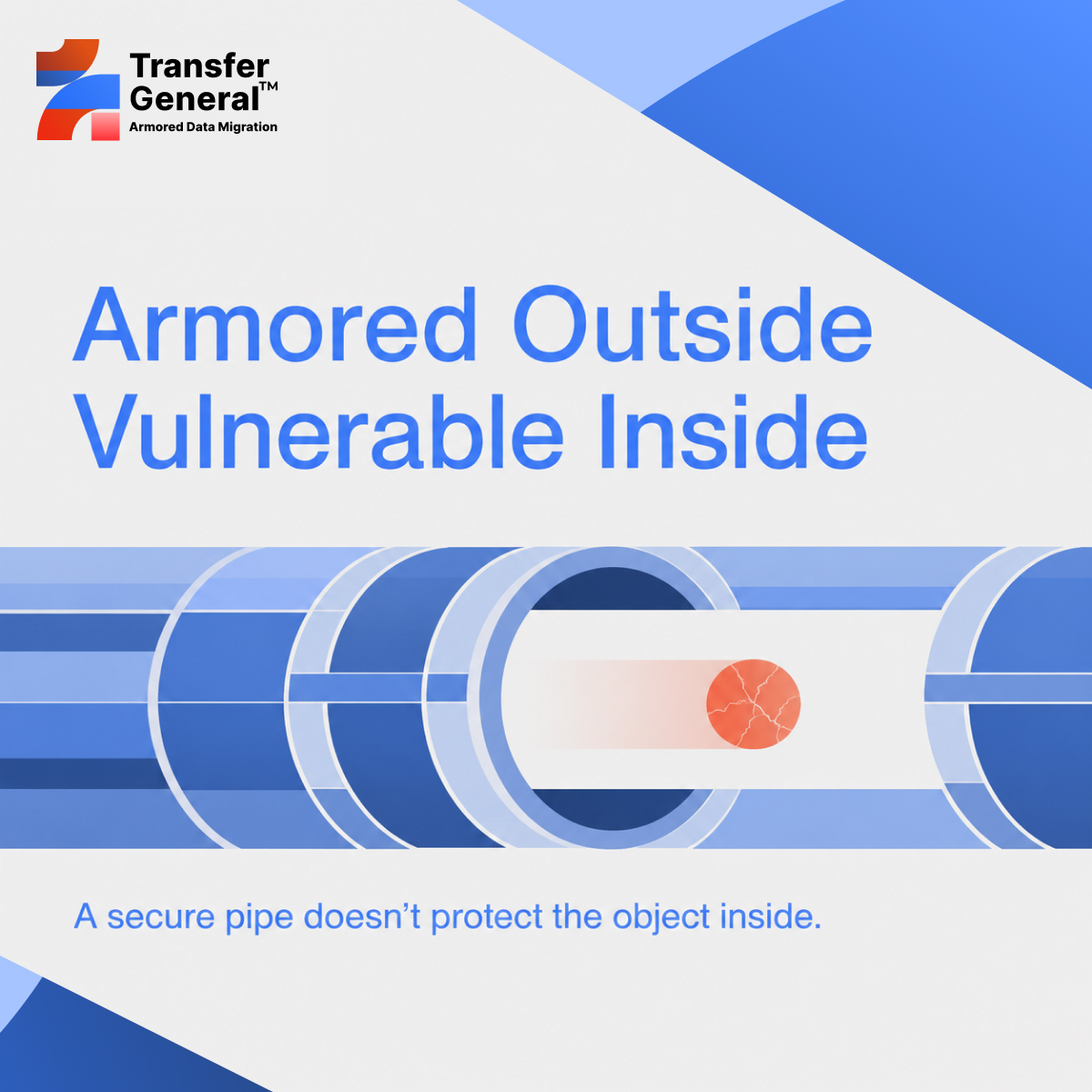
There are three layers of transport encryption most teams deploy for cross-cloud transfers: TLS, IPsec, and MACsec. Each one is legitimate, well-built, and does exactly what it was designed to do.
Here is what each layer actually covers — and what it cannot do.
TLS — What you already have.
TLS encrypts the data payload between your application and the CSP's service endpoint. It is automatic, it works, and it is the right starting point. But TLS protects the channel — not the object traveling through it. The channel and the object are not the same thing.
IPsec — Hiding the metadata.
Adding an IPsec VPN tunnel encrypts the entire packet, including headers. An observer sees two gateways communicating — not individual servers. But IPsec is software-based, consuming CPU on your cloud instances, adding latency and reducing throughput. Key management across two different CSPs — coordinating IKE parameters, pre-shared keys, and rotation schedules across different APIs and failure semantics — is genuinely painful.
MACsec — Hardware-grade, but hardware-gated.
MACsec operates at Layer 2, encrypting the entire Ethernet frame at near line-rate in NIC hardware. But it requires dedicated connections at 10 Gbps or 100 Gbps — AWS Direct Connect, GCP Cloud Interconnect. If your organization is not operating at that scale, MACsec is not an option.
The question nobody asks.
Every one of these layers protects the pipe. None of them protect the object traveling inside it. The pipe and the object are different things — and for regulated industries, that distinction is what compliance evidence is actually about.
Encrypt regulated data at the object layer — before it crosses any cloud boundary.
Transfer General encrypts at the object layer automatically, creating a stronger protection model for cross-cloud movement where compliance, defensibility, and evidence matter.
Request a PoC

.png)


.svg)

.png)
.png)